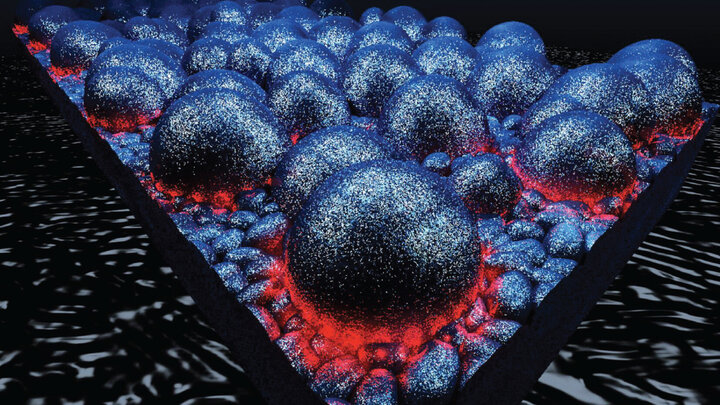
Collaborative research, including Nebraska research assistant professor Ufuk Kilic, electrical and computer engineering, provides the cover image for the January 9, 2026, issue of Advanced Optical Materials.
This work was funded partially by Nebraska’s Emergent Quantum Materials and Technologies (EQUATE) project, which is supported by the National Science Foundation. Kilic worked closely with former Nebraska faculty Mohammad Ghashami (also a past EQUATE seed grant recipient) and other collaborators on the cover image depicting a new class of laser-engineered thermal metamaterials with precisely tailorable emissivity. The featured article, “Advanced Emissivity Tuning Via Femtosecond Laser Surface Engineering,” introduces a scalable, top-down approach for engineering thermal radiation using femtosecond laser surface processing (FLSP) of titanium surfaces. This work engaged researchers from the Complex Material Optics Network and the Center for Electro-Optics and Functionalized Surfaces at Nebraska, as well as the Chicago Energy Engineering and Thermal Applications group at the University of Illinois Chicago.
By systematically tuning laser fluence and pulse count, the researchers generate self-organized Ti–TiOₓ core–shell mound structures, whose geometry and naturally formed oxide shell enable precise control over spectral and directional thermal emissivity. The laser-engineered surfaces exhibit highly enhanced, omnidirectional mid-infrared emission, which is critical for applications such as thermophotovoltaics, passive radiative cooling, and advanced thermal energy systems. A comprehensive experimental–theoretical framework combining Mueller matrix spectroscopic ellipsometry, finite element electromagnetic modeling, and detailed structural and chemical characterization reveals how key structural parameters govern near- and far-field light–matter interactions.
This collaborative research by Zahra Kamali Khanghah, Andrew Butler, Andrew Reicks, Juveriya Parmar, Eva Schubert, Craig Zuhlke, Mathias Schubert, Ufuk Kilic, and Mohammad Ghashami establishes femtosecond laser surface engineering as a powerful, lithography-free strategy for designing thermal metamaterials solely through intrinsic surface morphology and material chemistry. The results provide new physical insights and predictive design capability for emissivity control, positioning FLSP-engineered titanium platforms for future applications in energy, aerospace, and photonic thermal management technologies.
In addition to NSF funding, this collaboration was supported by the Air Force Office of Scientific Research, the University of Nebraska Foundation, and the J. A. Woollam Foundation.